


Self-coaching : 5 Proven Questions Successful leaders Actually Ask Themselves

Discover the proven self-coaching questions that successful leaders actually use daily. Transform your leadership with these powerful secrets today.
The primary distinction between extraordinary individuals and others is not attributable to luck or personal connections, but rather to the practice of self-coaching.
Embracing Self-Coaching for Personal Growth
High achievers routinely engage in self-inquiry by posing critical questions that promote personal growth and enhance performance. They have developed expertise in guiding their own development.
These questions function as intentional strategies designed to foster confidence and sustained progress. Rather than relying on external coaching, individuals can achieve significant growth through honest self-reflection and the willingness to implement insights gained.
The following five questions have the potential to transform daily routines into catalysts for significant achievement. These questions are often overlooked by others, providing a distinct advantage to those who utilise them.
1. What Truly Energised Me Today?
Personal energy levels can serve as indicators of authentic interests and strengths. By systematically tracking activities that increase engagement, individuals can identify their inherent capabilities.
When you finish something and feel more alive than when you started, pay attention. That’s not a coincidence—it’s alignment. Those moments when time disappears and engagement soars? They’re showing you where your authentic talents lie.
It is advisable to record instances of heightened energy daily and observe emerging patterns. For example, increased engagement may result from solving complex problems, achieving creative breakthroughs, or helping colleagues overcome challenges.
The objective is not to evade responsibilities, but to restructure daily activities in order to maximise engagement and minimise sources of fatigue. Incremental adjustments, such as scheduling energising tasks during peak performance periods and delegating less engaging activities when feasible, can yield substantial benefits.
Optimal performance is achieved when tasks align with both individual skills and intrinsic motivation. Identifying and operating within this intersection increases the likelihood of sustained success.
2. How Did I Challenge My Comfort Zone?

The Role of Social Connections in Self-Talk
Support from others can significantly influence our inner dialogue. Kross emphasizes the importance of balancing empathy and problem-solving when supporting someone else’s self-talk.
Comfort kills potential. Growth happens at the edge. Did you speak up when you usually stay silent? Pitch that idea despite your racing heart? Have the conversation you’ve been avoiding? These small acts of courage build your confidence muscle faster than any affirmation.
Success leaves clues. Look for the slight discomfort that accompanies meaningful growth. That flutter in your stomach isn’t weakness—it’s your expansion alarm sounding. Don’t confuse this with unnecessary stress. Strategic discomfort differs from random suffering. Choose challenges connected to your goals. Then celebrate taking action despite fear.
Your brain needs evidence you can handle uncertainty. Give it fresh proof daily. Tomorrow, identify one small boundary to push—then push it. Repeat until discomfort becomes your trusted growth signal rather than a warning to retreat.
3. What Story Am I Telling Myself?
Our internal narrative shapes everything. Catch it. Question it. Change it if needed. Are you silently repeating “I always mess up presentations” or “I’m terrible with numbers”? These stories aren’t facts—they’re assumptions your brain presents as truth. They’re also sabotaging your success.
Notice when you use words like always, never, impossible, or cannot in your self-talk. These words often reflect limiting beliefs rather than facts. Try to remember times when you succeeded in areas you thought were weaknesses. Think about exceptions to these negative thoughts, since reality is usually more complex than self-criticism suggests.
This isn’t about fake positivity. It’s about accuracy. Replace “I’m terrible at networking” with “I’m still developing my networking skills.” One closes doors. The other creates possibilities. Your results will only temporarily outperform your self-narrative. You can upgrade your story to elevate your ceiling.
4. What Victory, However Small, Can I Celebrate?

Celebrating micro-progress prevents all-or-nothing thinking
This practice helps combat perfectionism and the tendency to dismiss progress unless it’s dramatic. By recognizing incremental improvements, we develop a healthier relationship with growth and avoid the mental trap of feeling like failures when we don’t achieve massive breakthroughs immediately.
Progress fuels motivation. Perfection kills it. Spot your wins. Your brain has a negativity bias—it naturally fixates on what went wrong instead of what went right. Counter this by deliberately acknowledging daily victories.
Did you finally make that difficult call? Complete the first draft of that proposal? Maintain boundaries with that challenging client? These wins matter. Size is irrelevant. Consistency is everything. By training yourself to recognize progress rather than obsessing over perfection, you build resilience for the inevitable challenges ahead.
This practice creates tangible evidence of your capability—proof you’re making progress even when it feels slow. This evidence becomes invaluable during difficult stretches when motivation wavers. Tonight, identify one specific win from today. Write it down. Feel the satisfaction. Then wake up tomorrow ready to create your next victory.
5. What Would My Future Self Thank Me For?
Focusing only on the short term often leads to regrets later. Think about yourself a year from now. What could you do today that your future self would appreciate? Would they be glad you started a tough conversation, chose to learn a new skill instead of just relaxing, or set up automatic savings?
This perspective cuts through immediate gratification bias—our tendency to choose what feels good now over what creates lasting benefit.
Your future self doesn’t care about the temporary discomfort of discipline. They care about the compound results of consistent small actions: the manuscript you wrote page by page, the expertise you built practice by practice, the relationships you nurtured conversation by conversation. Let this future perspective guide today’s choices. Short-term pain for long-term gain isn’t just a catchy phrase—it’s the operating system of successful people.
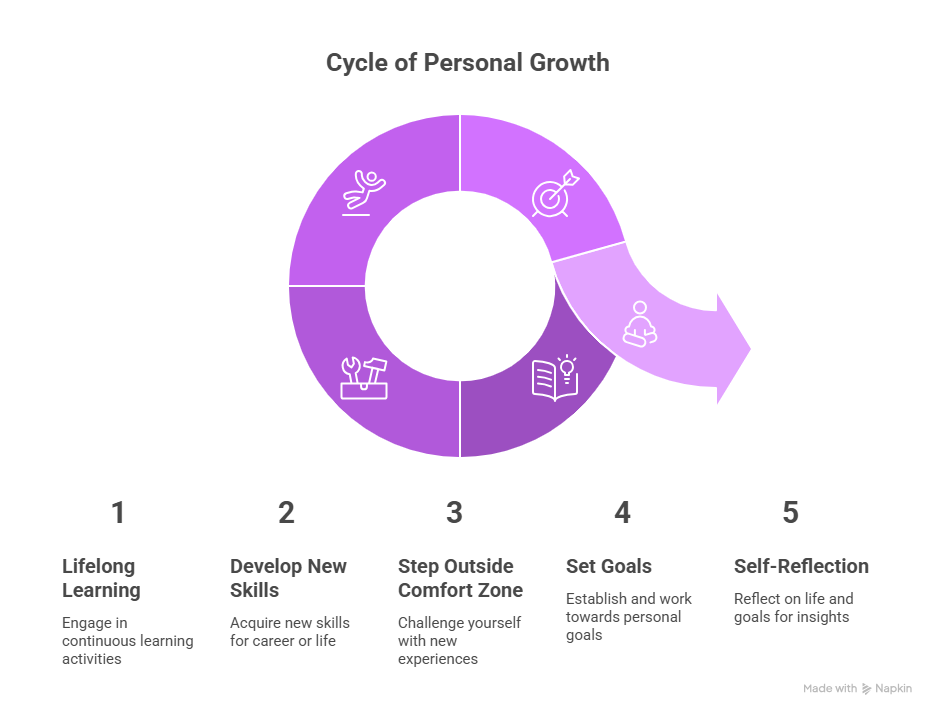
Continuous learning and self-improvement are essential for personal fulfillment. Your future self will thank you for investing in your personal growth.
Conclusion
Questions direct focus. Focus determines results. These 5 questions have transformed countless lives—including my own. The magic isn’t in knowing them but in using them consistently. Start today. Pick one question that resonates most strongly. Ask it every day for a week. Notice what changes. Then add another. These questions work because they address what truly drives success: clarity, courage, and consistent action. Your external world will always reflect your internal reality. Transform your questions, transform your life. Which question will you start with today?