


Master the STOP Technique: Your Complete Guide to Better Decision-Making

Unlock the proven STOP technique to empower your decisions. Our complete guide reveals game-changing strategies for confident, successful decision-making
Introduction
Have you ever made a decision you later wished you could take back? Whether it’s sending an angry email, making an impulse purchase, or reacting poorly to stress, we’ve all been there. The stop technique offers a simple yet powerful way to pause before acting. This proven method can transform how you handle daily situations by giving you the space to think before you react.
The stop technique helps you create better outcomes by making smarter choices, reducing stress, and building stronger relationships. Let’s see how this straightforward approach can improve your daily experiences.
Understanding the STOP Framework
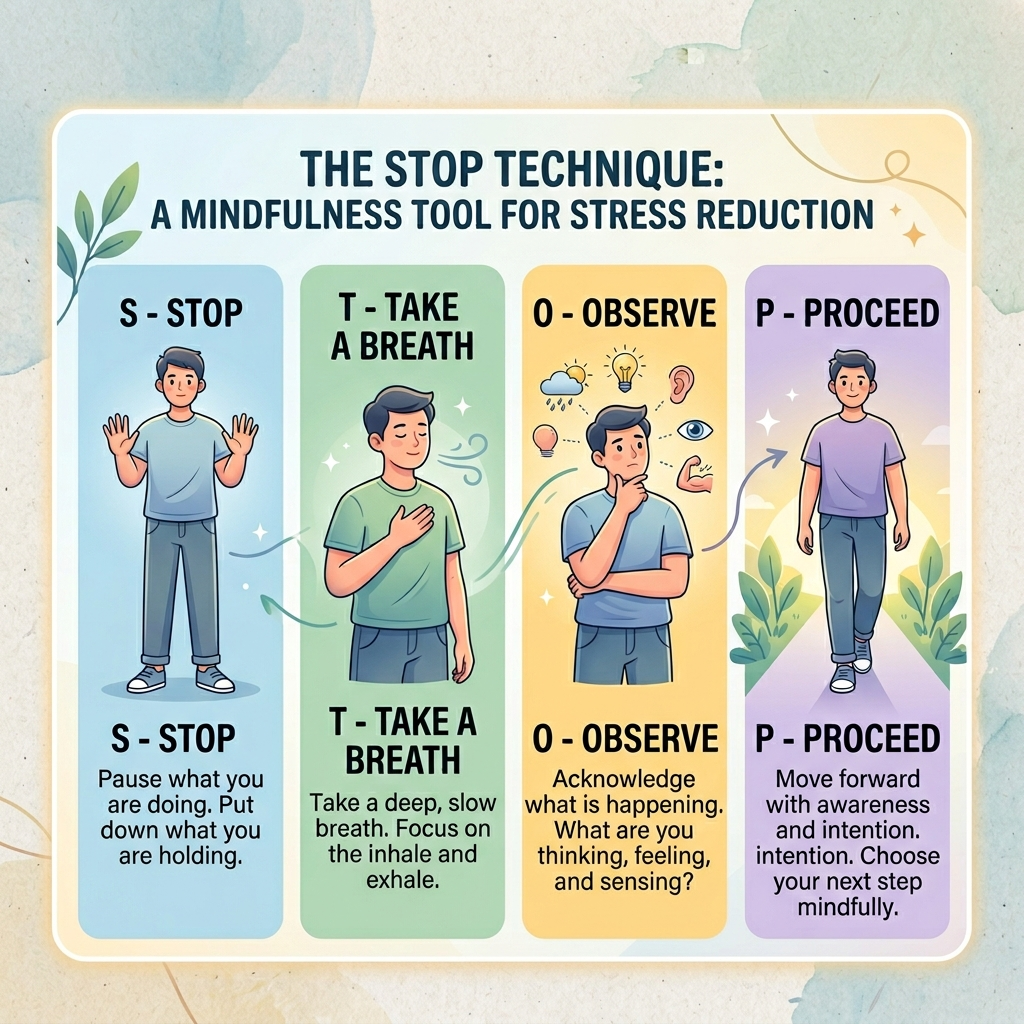
The STOP framework is a four-step process designed to help you pause and think before taking action. Each letter represents a specific step that guides you through a moment of reflection:
- S – Stop what you’re doing
- T – Take a breath
- O – Observe the situation
- P – Proceed with awareness
This framework interrupts automatic reactions, helping you consider options and choose the best course of action rather than acting on impulse.
You can use the STOP framework anywhere, anytime—at work, with family, or when facing personal challenges —and it requires no special training or equipment.
Why the STOP Framework Matters
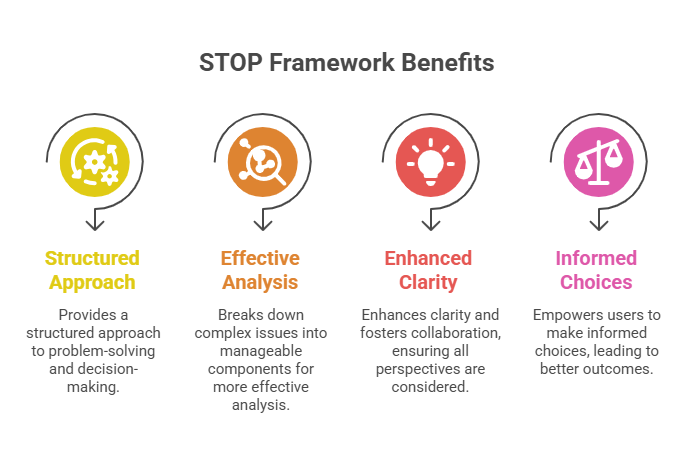
Our brains are wired to react quickly to perceived threats or opportunities. This served our ancestors well when facing physical dangers, but in today’s world, these quick reactions often cause more problems than they solve. The STOP framework helps bridge the gap between our automatic responses and our rational thinking.
According to Rhonda Magee, a professor of law at the University of San Francisco. Also trained in sociology and Mindfulness-Based Stress Reduction (MBSR), the STOP practice can help whenever you’re feeling distressed, creating space to observe and tame your feelings, and to access the deeper resources within you. It helps you develop the emotional intelligence and psychological flexibility required for greater mastery over the challenging moments.
The Science Behind STOP
The stop technique works by intentionally slowing down this process. When you pause and take a breath, you give your prefrontal cortex time to come online and provide input. This part of your brain excels at:
- Analyzing complex situations.
- Considering long-term consequences.
- Weighing different options.
- Regulating emotions.
- Making reasoned decisions.
Core Components of STOP
The core components of STOP work together to create a comprehensive pause-and-reflect system. Let’s examine each element in detail to understand how they contribute to better decision-making.
S – Stop What You’re Doing
The first component involves pausing your current activity. This might mean:
- Putting down your phone before responding to a frustrating text.
- Stepping away from your computer when feeling overwhelmed at work.
- Pausing mid-sentence during a heated conversation.
- Take your finger off the “send” button before posting on social media.
The key is to recognise the moment when you need to stop. This requires developing awareness of your emotional and physical signals. Common indicators include:
- Feeling your heart rate increase.
- Noticing tension in your shoulders or jaw.
- Experiencing a surge of anger or frustration.
- Feeling the urge to act immediately.
T – Take a Breath
The second component focuses on activating your body’s relaxation response. Deep breathing serves multiple purposes:
- It provides immediate stress relief.
- It increases oxygen flow to your brain.
- It activates the parasympathetic nervous system.
- It creates a natural pause for reflection.
Effective breathing techniques for the stop technique include:
- Box breathing: Inhale for 4 counts, hold for 4, exhale for 4, hold for 4
- Deep belly breathing: Breathe deeply into your diaphragm rather than your chest
- 4-7-8 breathing: Inhale for 4, hold for 7, exhale for 8
O – Observe the Situation
The third component involves gathering information about what’s really happening. This includes:
- Internal observation: Notice your emotions, thoughts, and physical sensations
- External observation: Assess the actual situation, other people’s perspectives, and environmental factors
- Factual assessment: Separate facts from assumptions or interpretations
During this phase, ask yourself questions like:
- What am I feeling right now?
- What triggered this reaction?
- What are the facts of this situation?
- How might others be perceiving this?
- What assumptions am I making?
P – Proceed with Awareness
The final component involves taking thoughtful action based on your observations. This means:
- Choosing a response that aligns with your values
- Considering short-term and long-term consequences
- Acting in a way that moves you toward your goals
- Communicating clearly and respectfully
Integration Strategies of STOP
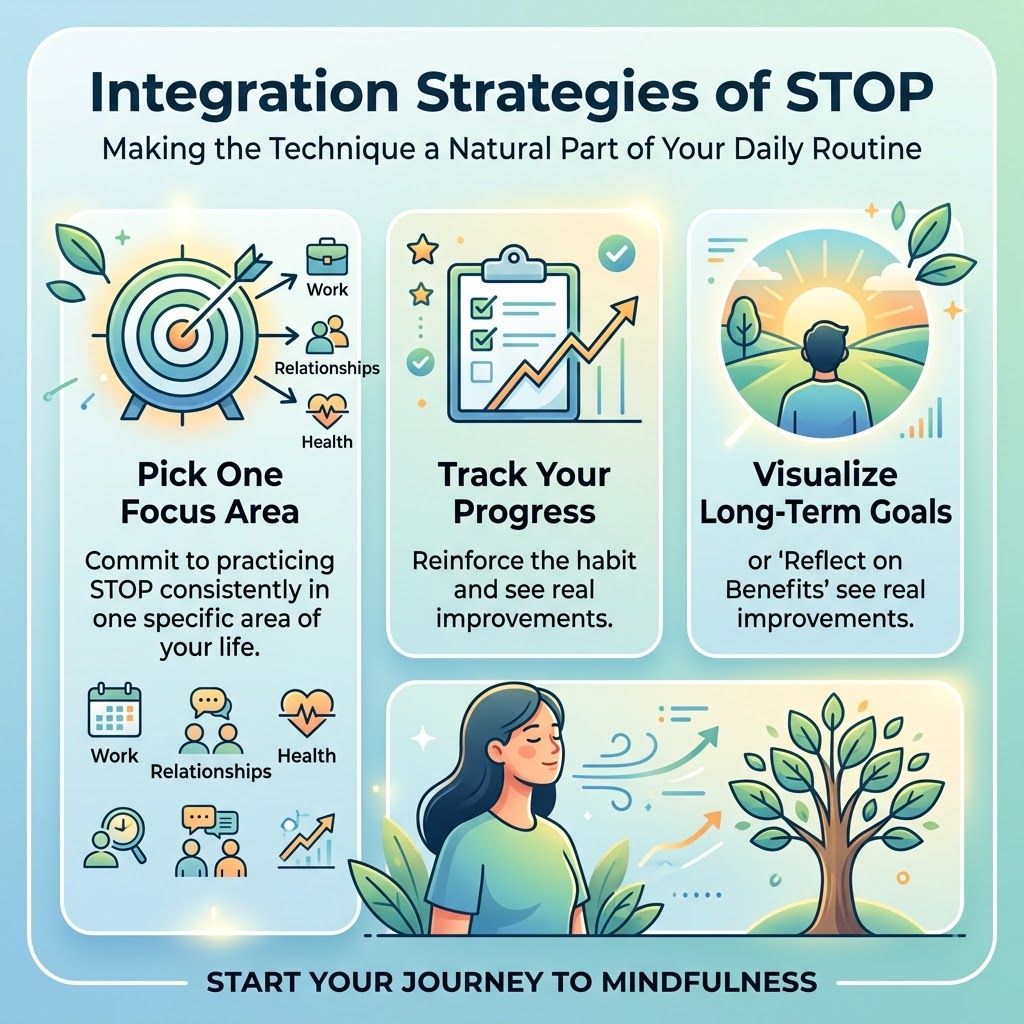
STOP’s integration strategies help you make this technique a natural part of your daily routine. Start by picking one area of your life to focus on and commit to practicing STOP consistently. Track your progress to reinforce the habit and see real improvements.
Common Challenges and Solutions of STOP
Common challenges and solutions of STOP help you troubleshoot difficulties you might encounter while learning and implementing this technique. Understanding these obstacles ahead of time can help you maintain consistent practice.
Challenge 1: Forgetting to Use the Technique
The Problem: In high-stress moments, you might forget to use the stop technique altogether.
Solutions:
- Set phone reminders throughout the day to practice STOP.
- Place visual cues in your environment (sticky notes, phone wallpaper).
- Practice during low-stress situations to build the habit.
- Start with just one specific trigger (like email) before expanding.
- Ask trusted friends or family members to remind you gently.
Challenge 2: Feeling Like You Don’t Have Time
The Problem: Believing that stopping will make you less productive or slow you down.
Solutions:
- Remember that the stop technique only takes 30-60 seconds.
- Consider the time costs of fixing mistakes made in reactive states.
- Start with situations where time pressure is less critical.
- Track how the technique actually improves your efficiency over time.
- Practice quick versions of STOP for urgent situations.
Challenge 3: Physical Reactions Are Too Strong
The Problem: When stress hormones are high, it can feel impossible to slow down.
Solutions:
- Accept that strong reactions are normal and don’t judge yourself.
- Focus extra attention on the breathing component.
- Use physical movement (like walking) as part of your STOP practice.
- Consider longer cooling-off periods for intense situations.
- Seek professional help if reactions feel unmanageable.
Challenge 4: Others Don’t Understand Your Pause
The Problem: People around you might interpret your pause as a sign of ignoring or unresponsiveness.
Solutions:
- Explain the stop technique to important people in your life.
- Use phrases like “Let me think about that for a moment”.
- Practice STOP in private when possible (like before responding to emails).
- Model the behavior consistently so others become familiar with it.
- Help others learn the technique to create mutual understanding.
Challenge 5: Overthinking During the Observation Phase
The Problem: Getting stuck in analysis and never moving to action.
Solutions:
- Set time limits for the observation phase (30 seconds to 2 minutes).
- Focus on facts rather than endless interpretation.
- Remember that “proceed” doesn’t require perfect information.
- Practice making decisions with incomplete data.
- Accept that some uncertainty is normal and healthy.
Real-Life Applications
The stop technique proves valuable across numerous real-life scenarios. Here are detailed examples of how people successfully apply this method:
Parenting Scenarios
Toddler Tantrums
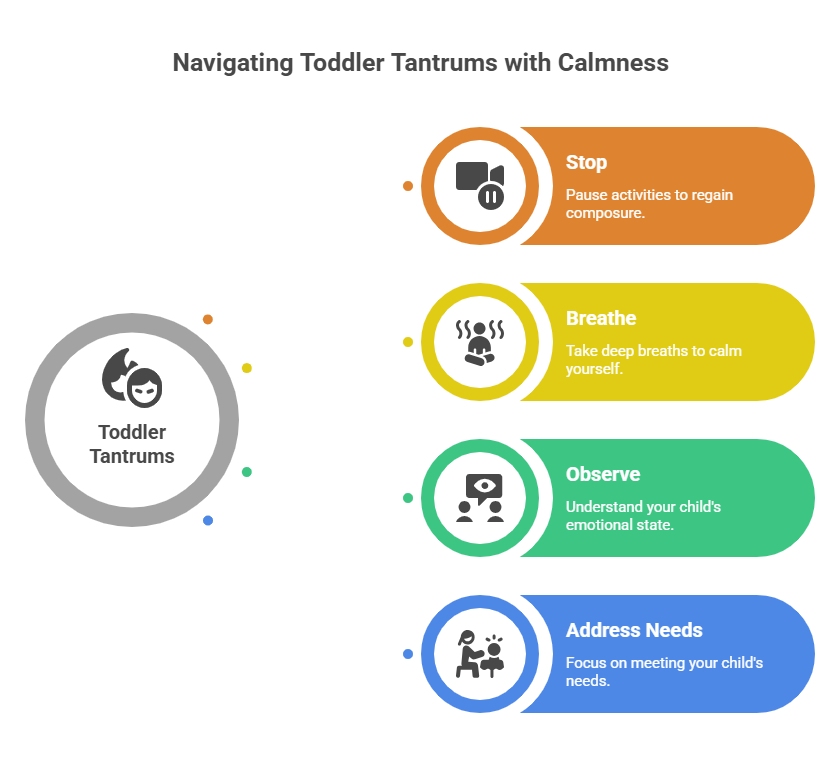
When your three-year-old has a meltdown in the grocery store, the stop technique helps you respond calmly rather than getting embarrassed or reactive. Stop what you’re doing, take a deep breath, observe that your child is overwhelmed and tired, and then address their needs rather than your embarrassment.
Teenage Conflicts
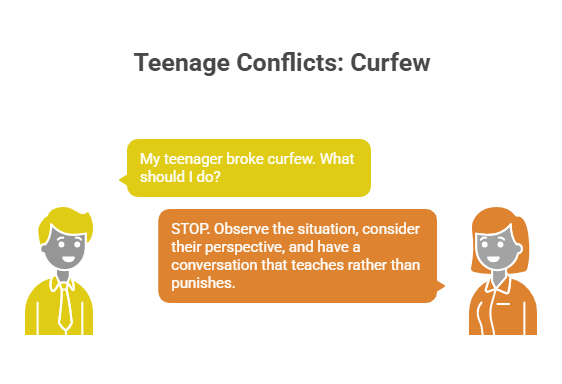
When your teenager breaks curfew, STOP helps you avoid lecturing immediately. Instead, you can observe the whole situation, consider their perspective, and proceed with a conversation that actually teaches rather than just punishes.
Professional Situations
Client Complaints: When a client sends an angry email about a project, the stop technique prevents defensive responses. You can observe the legitimate concerns behind their frustration and proceed with solutions rather than excuses.
Team Conflicts: During team meetings, when tensions rise, using STOP helps you facilitate rather than escalate conflicts. You can consider all perspectives and make statements that move the discussion forward constructively. nagement
Investment Decisions: Before making investment choices based on fear or greed, STOP helps you evaluate your long-term goals and risk tolerance objectively.
Major Purchases: When considering expensive items like cars or electronics, the technique helps you distinguish between wants and needs, leading to better financial choices.
Benefits of Using the STOP Technique
Regular practice of the stop technique provides numerous benefits that compound over time:
Emotional Benefits
- Reduced stress levels: Creating space between triggers and reactions naturally lowers stress.
- Better emotional regulation: You become less reactive and more responsive.
- Increased self-awareness: Regular observation builds understanding of your patterns.
- Greater emotional resilience: You bounce back faster from challenging situations.
Relationship Benefits
- Improved communication: Thoughtful responses strengthen relationships.
- Reduced conflicts: Fewer reactive interactions mean fewer unnecessary arguments.
- Increased empathy: Observation includes considering others’ perspectives.
- Better boundaries: You can respond to pressure with clarity rather than reactivity.
Professional Benefits
- Enhanced decision-making: Better choices lead to better outcomes.
- Increased productivity: Less time spent fixing reactive mistakes.
- Improved leadership: Others respect thoughtful responses.
- Career advancement: Better relationships and decisions support professional growth.
Personal Development Benefits
- Increased mindfulness: Regular practice builds present-moment awareness.
- Better self-control: You feel more in charge of your responses.
- Aligned actions: Your behaviors better match your values.
- Personal growth: Consistent reflection promotes continuous improvement.
Getting Started with STOP
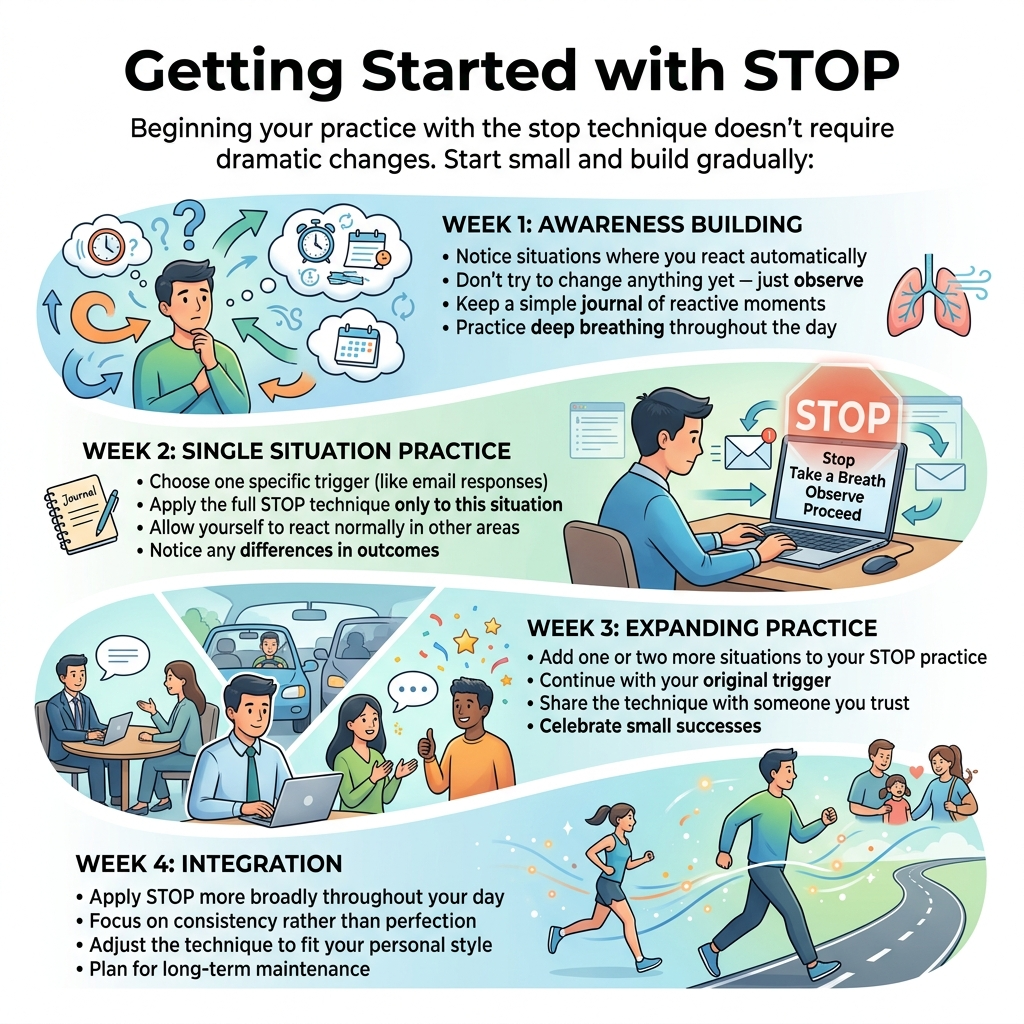
Beginning your practice with the stop technique doesn’t require dramatic changes. Start small and build gradually.
Creating Support Systems
- Find an accountability partner who also wants to improve their reactions.
- Join online communities focused on mindfulness or emotional intelligence.
- Consider apps that remind you to pause and breathe.
- Practice with family members so you can support each other.
Conclusion
The stop technique offers a simple yet powerful way to improve your daily life by improving your decision-making. By understanding the STOP framework and its core components, you can transform automatic reactions into thoughtful responses. The science behind STOP shows us why this approach works so effectively with our brain’s natural processes.
Integration strategies help you apply the stop technique across all areas of life, while awareness of common challenges prepares you for obstacles along the way. Remember that building this habit takes time and practice, but the benefits – reduced stress, better relationships, improved decision-making – make the effort worthwhile.
Ready to transform your reactions into responses? Begin practicing the STOP technique today and experience the difference thoughtful pausing can make. Share your results in the comments—we’re eager to know how the technique worked for you!