


Powerful Eisenhower Matrix: Energize Better Productivity

Do you ever feel like you’re constantly busy but never getting the important things done? If you’re drowning in tasks and struggling to figure out what to tackle first, the Eisenhower Matrix might be exactly what you need. This simple yet powerful tool has helped millions of people sort through their daily chaos and focus on what truly matters. But what is the Eisenhower Matrix method, and how can it change the way you manage your time?
Table of Contents
- What is the Eisenhower Matrix?
- Who Created the Eisenhower Matrix?
- History of the Eisenhower Matrix
- The Four Quadrants Explained
- How to Use the Eisenhower Matrix
- What is the Eisenhower Matrix Method in Practice
- Benefits of Using the Eisenhower Matrix
- Common Mistakes to Avoid
- Digital Tools and Apps
- Real-World Examples
What is the Eisenhower Matrix?
The Eisenhower Matrix is a simple decision-making tool that helps you organize tasks based on two key factors: urgency and importance. Think of it as a sorting system for your to-do list that separates the truly important work from the noise that fills up your day.
The matrix divides all tasks into four categories or “quadrants,” each requiring a different approach. Instead of working through a random list of tasks, you can quickly see which ones deserve your immediate attention and which ones you should ignore completely.
The beauty of this system lies in its simplicity. You don’t need special software or complex training. All you need is a basic understanding of the difference between urgent and important tasks, plus the discipline to stick with the system.
Who Created the Eisenhower Matrix?
Who created the Eisenhower matrix? The tool is named after Dwight D. Eisenhower, the 34th President of the United States and a five-star general during World War II. Eisenhower was famous for his ability to manage enormous responsibilities while maintaining focus on long-term goals.
However, the matrix as we know it today wasn’t exactly created by Eisenhower himself. The former president was known for his quote: “I have two kinds of problems, the urgent and the important. The urgent are not important, and the important are never urgent.” This insight became the foundation for what we now call the Eisenhower Matrix.
The actual matrix format was later developed and popularized by Stephen Covey in his bestselling book “The 7 Habits of Highly Effective People.” Covey took Eisenhower’s wisdom about prioritization and turned it into a practical, visual tool that anyone could use.
History of the Eisenhower Matrix
The history of the Eisenhower matrix begins in the 1950s with President Eisenhower’s approach to handling the massive responsibilities of leading a nation. As someone who had to balance urgent military decisions with long-term strategic planning, Eisenhower understood better than most how urgent tasks can crowd out important ones.
During his presidency, Eisenhower often spoke about the challenge of distinguishing between what seemed urgent and what was actually important for the country’s future. His insights on this topic became well-known in leadership circles.
The transformation from Eisenhower’s philosophy to the practical matrix we use today happened in the 1980s and 1990s. Stephen Covey and other productivity experts recognized the value of Eisenhower’s approach and developed it into a structured framework. The visual matrix format made it easier for people to categorize their tasks and make better decisions about how to spend their time.
Since then, the Eisenhower Matrix has become one of the most widely taught time management techniques in business schools, leadership programs, and personal development courses worldwide.
The Four Quadrants Explained
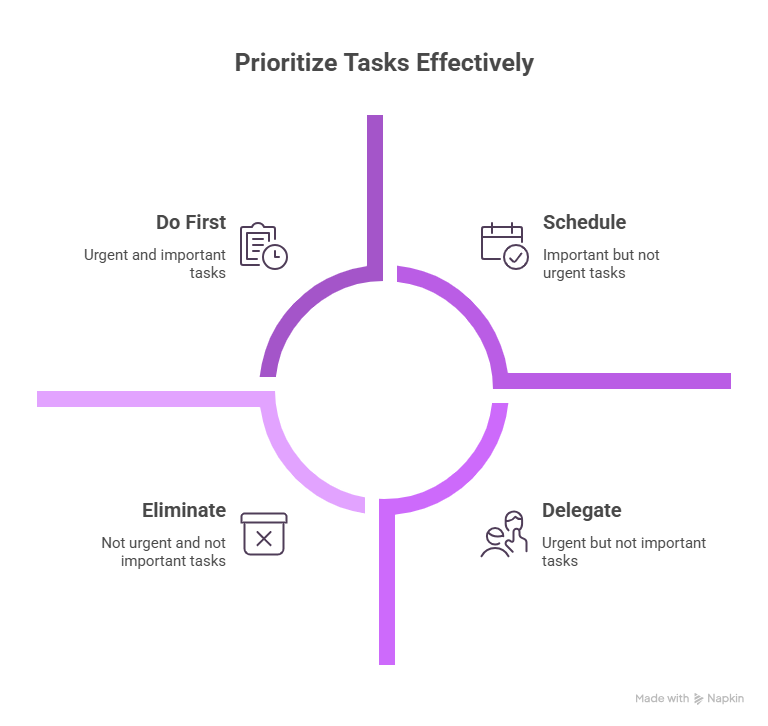
The Eisenhower Matrix divides tasks into four distinct quadrants based on two simple questions: “Is this urgent?” and “Is this important?” Here’s how each quadrant works:
Quadrant 1: Urgent and Important (Do First)
These are your crisis tasks that need immediate attention. Examples include:
- Medical emergencies
- Critical deadlines that affect your job or business
- Important meetings you can’t reschedule.
- Family crises requiring immediate response
Tasks in this quadrant demand immediate action. However, if you find yourself spending too much time here, it often means you’re not planning well enough in advance.
Quadrant 2: Important but Not Urgent (Schedule)
This is where the magic happens. These tasks contribute to your long-term goals but don’t have pressing deadlines. Examples include:
- Regular exercise and health maintenance
- Learning new skills for career advancement
- Building relationships with family and friends
- Strategic planning for your business or career
- Preventive maintenance on your car or home
Most successful people spend the majority of their time in this quadrant because it prevents many Quadrant 1 crises from happening in the first place.
Quadrant 3: Urgent but Not Important (Delegate)
These tasks feel urgent but don’t actually contribute much to your goals. Examples include:
- Most phone calls and text messages
- Many meetings and social events
- Some emails that demand immediate responses
- Requests for help that others could handle
The key with Quadrant 3 tasks is learning to delegate them or find more efficient ways to handle them.
Quadrant 4: Neither Urgent nor Important (Eliminate)
These are time-wasters that add no value to your life. Examples include:
- Mindless social media scrolling
- Watching too much television
- Gossiping or engaging in office drama
- Playing mobile games for hours
The goal is to eliminate or minimize time spent in this quadrant entirely.
How to Use the Eisenhower Matrix
Using the Eisenhower matrix effectively requires a systematic approach. Here’s a step-by-step process to get you started:
Step 1: List All Your Tasks
Start by writing down everything on your plate. Don’t worry about organizing it yet – just get it all out of your head and onto paper or a digital document.
Step 2: Draw Your Matrix
Create a simple 2×2 grid. Label the vertical axis “Important” at the top and “Not Important” at the bottom. Label the horizontal axis “Urgent” on the left and “Not Urgent” on the right.
Step 3: Define Important vs. Urgent
Before you start sorting, make sure you understand the difference:
- Important tasks contribute to your long-term goals, values, and mission.
- Urgent tasks require immediate attention, often driven by external pressures or deadlines.
Step 4: Sort Your Tasks
Go through your task list and place each item in the appropriate quadrant. Ask yourself two questions for each task:
- Does this contribute to my important goals? (Important vs. Not Important)
- Does this need to be done right away? (Urgent vs. Not Urgent)
Step 5: Take Action
- Do First: Handle Quadrant 1 tasks immediately
- Schedule: Block time for Quadrant 2 tasks in your calendar
- Delegate: Find ways to assign Quadrant 3 tasks to others
- Eliminate: Remove or minimize Quadrant 4 activities.
Step 6: Review and Adjust
Use the matrix daily or weekly to keep your priorities clear. As new tasks come up, immediately categorize them before adding them to your schedule.
What is the Eisenhower Matrix Method in Practice
What is the Eisenhower Matrix method when you apply it to real life? It’s more than just a sorting exercise – it’s a complete shift in how you think about your time and energy.
Daily Implementation
Start each day by reviewing your tasks through the lens of the matrix. Instead of just looking at your to-do list and feeling overwhelmed, you can quickly identify what needs immediate attention and what can wait.
For example, if you’re a busy professional, your morning might include checking for any Quadrant 1 emergencies (urgent emails from your boss, family emergencies), then immediately moving to your scheduled Quadrant 2 activities (important project work, strategic planning).
Weekly Planning
The matrix becomes even more powerful when you use it for weekly planning. Spend 30 minutes each Sunday or Monday morning categorizing the upcoming week’s tasks. This prevents you from falling into the trap of spending entire days on urgent but unimportant activities.
Long-term Perspective
The real power of the Eisenhower Matrix method lies in how it changes your long-term behavior. As you become better at identifying truly important tasks, you’ll naturally spend more time preventing crises rather than responding to them.
Most people who use this method consistently find that their Quadrant 1 (crisis) time decreases significantly over the first few months. This happens because spending more time on Quadrant 2 activities prevents many problems from becoming urgent in the first place.
Benefits of Using the Eisenhower Matrix
According to research conducted by UK-based Development Academy in 2021, the Eisenhower Matrix was the most successful time management technique. The organization surveyed 500 people across a wide variety of industries
The advantages of implementing the Eisenhower Matrix extend far beyond simple task organization:
Reduced Stress and Overwhelm
When you can clearly see which tasks truly matter and which ones don’t, the overwhelming feeling of having “too much to do” naturally decreases. You’ll feel more in control of your time and less reactive to every urgent request that comes your way.
Better Decision Making
The matrix forces you to think critically about each task’s true value. This daily practice of evaluation improves your overall decision-making skills in all areas of life.
Increased Focus on Goals
By regularly identifying and prioritizing important tasks, you’ll make consistent progress toward your long-term objectives rather than just responding to whatever seems urgent at the moment.
Improved Work-Life Balance
The matrix helps you recognize when work tasks are bleeding into personal time unnecessarily. You’ll become better at protecting time for important personal activities, such as family, health, and relationships.
Enhanced Productivity
Instead of staying busy with unimportant tasks, you’ll spend more time on activities that create real results. This leads to better performance at work and more satisfaction in your personal life.
Prevention-Focused Mindset
Regular use of the matrix develops a prevention-focused approach to life. You’ll start thinking ahead and addressing potential problems before they become crises.
Common Mistakes to Avoid

Misclassifying Urgent vs Important Due to Emotional Bias
Many people confuse emotional intensity with urgency, leading to poor task categorization. A heated email from a colleague might feel urgent, but may actually be neither urgent nor important. The key is to pause and objectively assess whether the task has a real deadline and contributes to your long-term goals, rather than reacting to the emotional charge of the situation.
Even with a clear understanding of the Eisenhower Matrix, many people make predictable mistakes when first implementing the system:
Confusing Urgent with Important
The biggest mistake is treating everything as urgent, as if it were also important. Just because someone else’s poor planning creates urgency doesn’t mean the task aligns with your goals. Learn to question urgency and ask whether the urgent task truly matters in the bigger picture.
Neglecting Quadrant 2
Many people understand the matrix intellectually but still spend most of their time in Quadrants 1 and 3. Remember that Quadrant 2 (important but not urgent) is where you should spend the majority of your time for long-term success.
Not Scheduling Important Tasks
Understanding that something is important isn’t enough – you must actually schedule time for it. If you don’t block time in your calendar for Quadrant 2 activities, they’ll never happen because urgent tasks will always push them aside.
Being Too Rigid
The matrix is a tool, not a rule. Some flexibility is necessary, especially in genuine emergencies. The goal is to use it as a guide for better decision-making, not to become obsessed with perfect categorization.
Failing to Delegate Effectively
Many people correctly identify Quadrant 3 tasks, but then try to handle them more efficiently rather than delegating them. True delegation means training others to handle these tasks so they don’t come back to you.
Not Reviewing and Updating
The matrix only works if you use it consistently. Set up a regular review schedule – daily for task management and weekly for bigger picture planning.
Digital Tools and Apps

Numerous productivity applications, including Asana, Todoist, and Atlassian tools, integrate with or support the Eisenhower Matrix, thereby facilitating its digital implementation. The Eisenhower Matrix is particularly valuable in fast-paced environments where frequent demands may impede meaningful progress.
While the Eisenhower Matrix works perfectly with pen and paper, several digital tools can make the process more efficient:
Dedicated Matrix Apps
- Priority Matrix: Specifically designed around the Eisenhower Matrix concept.
- Focus Matrix: Simple, clean interface for categorizing tasks.
- Eisenhower: Minimalist app focused solely on the four-quadrant system.
General Productivity Apps with Matrix Features
- Todoist: Includes priority levels and project organization that work well with the matrix.
- Notion: Customizable database features allow you to create your own matrix system
- Trello: Board and card system can be organized into four quadrants
Simple Solutions
- Google Sheets or Excel: Create a simple four-quadrant template
- Physical whiteboard: Perfect for team environments where everyone can see priorities
- Notebook or planner: Many people prefer the tactile experience of writing by hand
The key is choosing a system you’ll actually use consistently. Don’t get caught up in finding the perfect app if a simple piece of paper works better for your lifestyle.
Real-World Examples
To understand how The Eisenhower Matrix works in practice, let’s look at how different people might use it:
Small Business Owner
Quadrant 1: Customer complaint requiring immediate response, payroll deadline
Quadrant 2: Strategic business planning, employee training, marketing strategy development
Quadrant 3: Non-essential vendor calls, routine administrative tasks
Quadrant 4: Browsing social media during work hours, attending networking events with no clear purpose
Working Parent
Quadrant 1: Child’s sudden illness, urgent work deadline, car breakdown
Quadrant 2: Regular family time, exercise, skill development for career advancement, preventive healthcare
Quadrant 3: PTA meetings (if not aligned with family goals), most social media requests
Quadrant 4: Mindless TV watching, gossiping with neighbors
College Student
Quadrant 1: Upcoming exam in two days, assignment due tomorrow
Quadrant 2: Regular study sessions, building relationships with professors, internship applications, health, and exercise
Quadrant 3: Club meetings that don’t align with goals, social events you don’t enjoy
Quadrant 4: Video games, social media scrolling, Netflix binges
Notice how the same type of activity might fall into different quadrants for different people, depending on their goals and circumstances.
Conclusion
The Eisenhower Matrix offers a simple but powerful way to take control of your time and focus on what truly matters. By distinguishing between urgent and important tasks, you can break free from the constant reactive mode that leaves so many people feeling busy but unproductive.
The key to success with this system lies in consistent application and honest evaluation of your tasks. Start small by using the matrix for just one day, then gradually expand to weekly and monthly planning. Remember that the goal isn’t perfect organization – it’s making better decisions about how you spend your limited time and energy.
Whether you’re managing a business, raising a family, or pursuing personal goals, the principles behind the Eisenhower Matrix can help you focus on what matters most and spend less time on activities that don’t move you forward.
Ready to take control of your time? Start by listing five tasks you need to complete this week, then practice categorizing them using the four quadrants. Share your experience in the comments below and let us know which quadrant you struggle with most!
Your Guide to Clarity and Focus.” The ebook should provide a complete system for implementing the Eisenhower Matrix, including step-by-step instructions for categorizing tasks by importance and urgency, daily planning templates, stress-reduction techniques, and decision-making frameworks.