


Proven Secrets: 7 Thrilling Self-Sabotage Life Patterns

Learn the thrilling truth about 7 self-sabotage Life patterns blocking your growth—proven strategies to overcome mental barriers and achieve lasting success.
Understanding Self-Sabotage Life Patterns
Self-sabotage silently kills your potential. Just as you’re ready to become your own coach, invisible barriers may appear. Recognizing these barriers is as crucial as knowing how to move forward, because it empowers you to overcome them.
These seven self-sabotage patterns aren’t just obstacles – they’re growth killers. But here’s the good news: once you spot them, you can crush them with strategies like journaling or affirmations. Ready to unlock your inner coach and build unstoppable confidence?
Let’s dismantle these barriers one by one and clear the path to your success. The inner wisdom you need is already inside you – let’s remove what’s blocking it and help you realize your potential.
1. The Perfectionist’s Paralysis: Progress Beats Perfect
Perfectionism isn’t a virtue. It’s a prison. When you demand flawless outcomes before taking action, you freeze yourself in place. Your inner coach – the part that grows through experience – gets muzzled by impossible standards.
The Hidden Cost of “Perfect”
Every task becomes high-stakes when perfectionism takes over. A simple email? One hour of rewriting. A presentation? Never quite ready. Projects? Forever “in progress” as you tinker endlessly. Worst of all? This pattern wears a disguise. You might even brag about being a perfectionist, not realizing it’s stopping you from taking the imperfect actions that create real growth.
Research has indicated that perfectionism is prevalent among adolescents and may be harmful in terms of its association with mental health problems.
Break the Pattern Now
Your inner coach thrives on progress, not perfection. It knows learning happens in the messy middle.
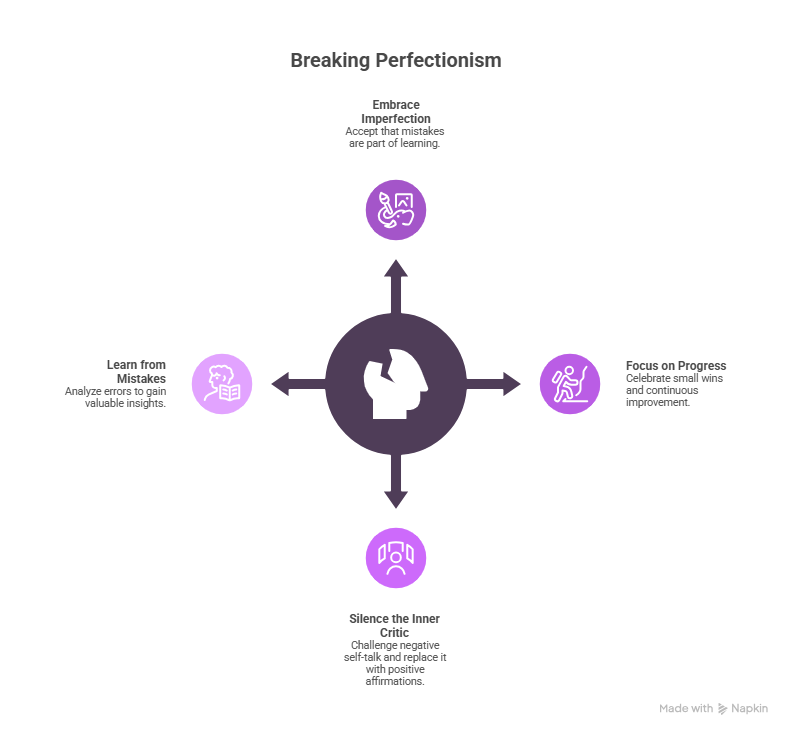
Keep in mind that perfectionism often comes from fear—fear of being judged, criticised, or feeling not good enough. Try to face this fear and keep moving forward. Your inner coach wants you to know that someone who takes imperfect action will always get further than someone who waits for the perfect move.
2. Emotional Reasoning Trap: Feelings Aren’t Facts
Your emotions lie to you. Emotional reasoning turns temporary feelings into permanent “truths.” It’s the voice saying, “I feel overwhelmed, so this task must be impossible” or “I feel inadequate, so I must be unqualified.”
What is the Emotional Reasoning Trap?
Emotional reasoning is a common cognitive distortion, or a flawed way of thinking, identified in cognitive behavioural therapy (CBT). It happens when you see your emotions as proof that something is true. The main idea is: “I feel it, therefore it must be true.” This is why people often say, feelings aren’t facts.
When Emotions Hijack Reality
This pattern fosters a distorted internal dialogue. Experiencing anxiety may be interpreted as evidence of inadequacy, while a single unmotivated day can lead to the belief that one is inherently lazy. Such emotional interpretations often solidify into limiting beliefs that are difficult for your inner coach to address.
Your inner coach recognises emotions as valuable data but understands that they are inadequate substitutes for rational analysis. By refraining from allowing transient feelings to define your abilities, your inner guide is better positioned to offer guidance based on insight rather than emotional impulse.
3. The Compare and Despair Cycle: Run Your Own Race
Comparison is a thief. It steals your joy, motivation, and clarity. When you measure your messy reality against others’ highlight reels, you create a mental environment where your inner coach can’t establish proper benchmarks.
The Comparison Trap
The cycle is predictable: you scroll social media seeing polished achievements; compare them to your behind-the-scenes struggles; feel inadequate; then despair about your progress. This cycle doesn’t just hurt – it actively blocks your inner coach from functioning.
Why? Your inner guide needs accurate data. It needs to know your true starting point, available resources, and authentic definition of success. Comparison corrupts this data with false benchmarks based on incomplete information.
Break Free From Comparison

Studies indicate that time spent on social media feeds, which amplifies social comparisons, increases depression and envy, and decreases overall well-being.
Escaping this cycle requires awareness and strategic action:
- Recognize the highlight reel effect – Remember that social media shows outcomes, not processes. For every “overnight success” you see, there are years of invisible struggles and failures.
- Create personal metrics – Define success on your terms with concrete, measurable indicators that matter to you. Track improvement against your past self, not others’ results.
- Curate your input – Audit your information diet. Limit content that triggers comparison. Follow accounts showing authentic journeys, not just glossy results.
- Document your wins – Keep a progress journal. Record your growth and small victories. Review it when comparison threatens your self-perception.
- Turn comparison into learning – When caught comparing, ask: “What specific skill could I learn from this person?” This transforms unproductive comparison into strategic growth.
Comparison is toxic because it compares incomparable things. Everyone has different starting points, resources, challenges, and definitions of success. Your inner coach knows this – but needs your help maintaining perspective.
The best antidote? Connection. Share your real struggles and hear others share theirs. This breaks the isolation that makes comparison so powerful. Your inner coach thrives on accurate information about where you are and where you want to go. Break the comparison cycle and create space for guidance that’s truly yours – not borrowed from someone else’s highlight reel.
4. Future-Tripping Instead of Present Action: Do Now, Dream Later
Future-tripping keeps you stuck. This habit of obsessing over potential outcomes rather than focusing on immediate steps completely derails your progress. You either catastrophize everything that could go wrong or get lost in success fantasies without taking necessary action.
The Future Focus Problem
When caught in this pattern, you waste hours worrying about presentation disasters, imagining criticism, or visualizing worst-case scenarios. Or you lose yourself in success fantasies without taking the actual steps to make them real. Both extremes – catastrophizing and idealizing – prevent your inner coach from guiding your actual growth.
This habit feels productive because you’re “thinking about your goals.” But excessive future focus creates a gap between planning and doing. Your inner coach works best in the present moment, guiding immediate actions based on real-time feedback.
Bring Your Focus Back to Now
Breaking this pattern requires returning your attention to the present:
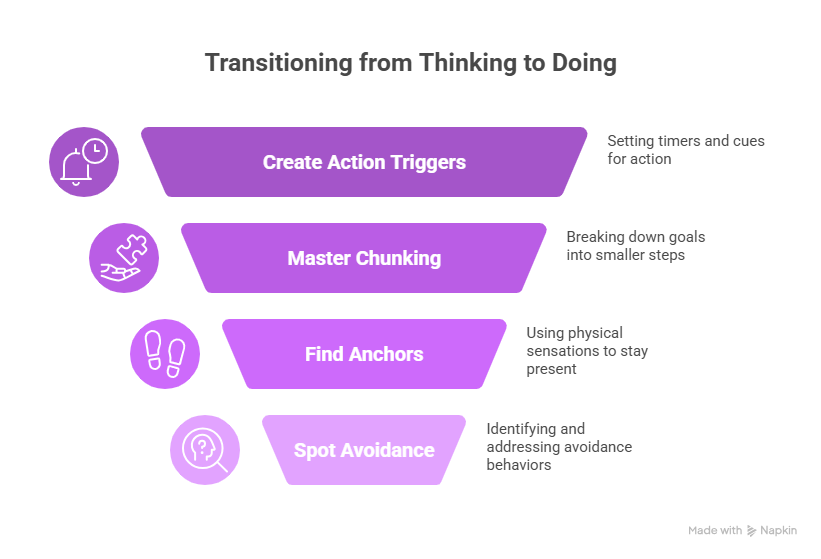
Your inner coach balances planning and execution but needs your help maintaining the right mix. Recognize when you’re using future scenarios to escape present action.
Remember: The future is created by a series of present moments. Each time you choose present action over future speculation, you strengthen your inner coach’s ability to guide you through uncertainty.
No significant achievement happens through a single leap into the future – it’s built from present-moment choices strung together over time.
5. All-or-Nothing Thinking: Embrace the Gray Area

The “Good Enough” Principle Can Outperform Perfectionism
Embracing partial success and incremental progress often yields better long-term results than pursuing absolute outcomes. Studies in behavioral psychology demonstrate that people who accept “good enough” solutions tend to be more productive, less anxious, and more likely to maintain consistent progress toward their goals.
Black-and-white thinking kills progress. This common mental trap views everything in binary terms – complete success or utter failure – with no middle ground. When this pattern takes over, you disable the nuanced guidance your inner coach needs to provide.
The Binary Thinking Trap
This pattern shows up everywhere: Miss one workout? Your fitness plan is ruined. Make a single mistake? The entire project is a failure. Slip on your diet? Time to abandon all healthy habits. These extreme interpretations create a mental environment where your inner coach can’t function.
Your inner guide thrives on gradual progress and learns from setbacks. It understands growth is rarely linear and never perfect. But all-or-nothing thinking rejects this reality, demanding perfection and labeling anything less as complete failure.
Find Comfort in the Middle Ground
Breaking this pattern requires embracing the space between extremes:
- Switch to percentage thinking – Instead of seeing tasks as done or not done, assess by degree. “I completed 70% of my goal today” acknowledges partial progress.
- Create success spectrums – For important goals, define multiple levels between “complete failure” and “perfect success.” What would 25%, 50%, and 75% success look like?
- Use the phrase “and also” – When caught in binary thinking, add complexity: “I missed my deadline AND ALSO I learned valuable information about how long these tasks actually take.”
- Adopt the 1% better approach – Focus on tiny improvements rather than dramatic transformations. Ask: “How can I make this 1% better today?” This sidesteps the all-or-nothing trap.
- Extract learning from everything – Train yourself to automatically ask: “What can I learn from this?” after any outcome. This transforms black-and-white results into valuable data.
All-or-nothing thinking often comes from perfectionism and fear of failure. By recognizing these drivers, you can respond with self-compassion rather than harsh judgment.
Your inner coach naturally understands nuance and complexity. It knows meaningful progress happens in the gray areas between total success and complete failure. By breaking this pattern, you allow your inner coach to provide balanced, realistic guidance.
Remember: Successful people aren’t those who never fail – they’re those who see setbacks as temporary and partial, not permanent and complete.
6. Permission-Seeking From External Voices: Trust Your Gut
Constantly seeking validation before acting cripples your growth. When you habitually need outside permission – from experts, friends, or social media – you train yourself to ignore your inner coach’s wisdom and direction.
The External Validation Addiction

It Operates Through a Dopamine Loop Similar to Substance Addiction
External validation triggers the brain’s reward system by releasing dopamine when we receive likes, comments, or praise. Positive social feedback from peers and caregivers helps foster social skills, self-esteem, and a sense of belonging. As individuals age, social feedback continues to influence behavior, reinforcing social bonds and maintaining relationships.
This pattern shows up as: waiting for multiple opinions before deciding; regularly asking “What do you think I should do?” before taking action; feeling unable to trust your judgment without confirmation; or needing likes and comments to validate your ideas.
While seeking input can be valuable, excessive permission-seeking creates dependency that mutes your internal guidance system. The problem isn’t occasionally seeking advice – it’s habitually deferring to external voices over your own.
Rebuild Trust in Your Judgment
Breaking free requires strengthening your self-trust muscle:
- Start a decision journal – Record choices you make without seeking permission, then track outcomes. Over time, you’ll build evidence of your capability to make sound independent decisions.
- Practice small autonomous choices – Begin with low-stakes decisions made entirely on your own. Gradually increase the significance as your confidence grows.
- Implement a “me first” policy – Before seeking any external opinion, fully develop your own perspective first. Write it down to prevent it from being prematurely influenced.
- Set consultation limits – When you do seek input, decide in advance exactly how many people you’ll consult and stick to that number. This prevents endless opinion-gathering.
- Distinguish information from reassurance – Ask yourself: “Am I looking for specific information I don’t have, or just seeking reassurance for a decision I already know how to make?”
Your inner coach possesses tremendous wisdom drawn from your unique experiences, values, and goals. External advice, while sometimes helpful, often fails to account for these personal factors.
Remember: Seeking input becomes problematic when it substitutes for developing self-trust. The most confident people aren’t those who never seek advice – they’re those who can incorporate outside perspectives while maintaining their own center of gravity.
Your inner coach speaks most clearly when you create quiet space to listen. Reduce the noise of constant external validation, and you’ll recognize the guidance that’s been there all along.
7. The “Not Enough” Narrative: Start Before You’re Ready
I’m not enough” is the ultimate self-sabotage. This persistent belief – that you lack sufficient knowledge, resources, talent, or readiness – becomes a self-fulfilling prophecy that silences your inner coach’s calls to action.
“You’re more prepared than you think, and less prepared than you’ll ever feel.”
The Myth of Readiness
This pattern shows up constantly: “I need one more course before starting.” “I don’t have enough experience for that position.” “I need better equipment before I begin.” “I’m not confident enough to speak up.”
While occasionally reflecting reality, these statements more often protect you from the vulnerability of trying and potentially failing. The power of this narrative comes from its partial truth. Yes, more knowledge or resources might help – but waiting for perfect conditions becomes an endless delay tactic.
Your inner coach knows most growth happens through action and adjustment, not perfect preparation.
IMPOSTOR Syndrome Decreases Through Action, Not Preparation
Contrary to popular belief, additional preparation often intensifies imposter syndrome rather than reducing it. The more you study without doing, the larger the gap feels between theoretical knowledge and practical application. Neuroscience research reveals that confidence-building neural pathways only strengthen through experiential learning, not passive consumption of information.
“Imposter syndrome is the voice inside your head telling you that you don’t belong, while discrimination is the voice of others telling you the same thing,” explains Dr. Albers.
Challenge the Narrative and Create Momentum
Breaking this pattern requires honest assessment and immediate action:
- Do a reality check – Ask specific questions: “What’s the minimum knowledge actually required to begin?” or “Who has succeeded with similar or fewer resources than I currently have?” Separate legitimate prerequisites from excuses.
- Apply the 70% rule – When you feel about 70% ready – having most but not all you need – that’s often the optimal time to begin. Waiting for 100% typically leads to missed opportunities.
- Create a “sufficiency inventory” – List everything you already have that supports your goal: skills, knowledge, resources, connections, and experiences. Counter the tendency to focus on what’s missing.
- Practice “starting before ready” – Deliberately begin projects slightly before you feel fully prepared. This builds the muscle of acting despite the “not enough” feeling.
- Reframe “not enough” as “becoming” – Instead of “I’m not good enough at public speaking,” try “I’m becoming a more confident speaker with each presentation.” This acknowledges growth as an ongoing process.
Your inner coach knows meaningful growth happens at the edge of your comfort zone – where you have enough to begin, but not enough to guarantee success.
Remember: The most successful people aren’t those who wait until all conditions are perfect – they’re those who leverage what they have while continuously improving. Your inner coach is ready to guide this journey of action and adaptation.
The truth? You are enough to start. And starting is how you become enough for what’s next.
Conclusion
our inner coach is ready – are you? These seven self-sabotage patterns aren’t permanent roadblocks; they’re simply habits waiting to be broken. The path forward is clear: Spot these patterns when they emerge. Challenge them with the strategies you’ve learned. Take immediate action, however imperfect. Your ability to coach yourself exists right now, beneath these layers of self-limiting behaviors.
What’s your next move? Choose just one pattern that resonates most strongly and commit to breaking it this week. Start small. Be consistent. Watch what happens when you remove even one barrier between you and your inner wisdom. Remember, self-coaching mastery isn’t about perfection – it’s about progress. Your journey to confidence,